
7 Kinds of Hackathons Worth Your Weekend, Sponsorship or Donation
The best hackathons are the ones that match what you want to walk away with: a shipped project, a …
Read More
A plain-language explainer on hackathon judging: criteria, rubrics, scorecards, how winners are picked, and how sponsors, builders and volunteers fit in.
When a hackathon weekend winds down, the room changes. Teams stop typing, laptops get plugged into projectors, and a handful of people with clipboards or laptops start walking from table to table. Those people are the judges, and the next few hours decide which projects walk away with prizes, introductions and bragging rights.
I run C.O.D.E Philadelphia, a volunteer-run nonprofit of developers and engineers, and our quarterly hackathons at venues like Pennovation Works end this way every time. Over many events we have watched first-time builders, senior engineers, sponsors and donors all ask the same thing: how does judging work, and is it fair? This explainer is our answer. It covers the criteria judges use, how a rubric and a scorecard differ, how winners get chosen, and where sponsors, donors and volunteers fit in the process.
Hackathon judging is the process a hackathon uses to evaluate submitted projects and pick winners. A panel of judges scores each project against published criteria, usually with a rubric and a scorecard, after watching a demo or reviewing a submission. It matters to builders who want to win or learn, to sponsors whose prizes and reputation ride on a fair result, and to donors who want evidence that the event rewards real work.
Hackathon judging exists because a hackathon is a competition with a time limit, and someone has to decide what “best” means within it. Without judges, the event has no way to recognize the teams that built something impressive in a single weekend or a single day.
Judging also does work beyond picking winners. A judge’s questions during a demo are often the first outside feedback a team gets on an idea. For early-career developers and bootcamp graduates, a two-minute conversation with an experienced engineer can be more useful than the prize itself. For sponsors, judging is where their brand meets the projects built on their tools or around their challenge.
A typical judging panel mixes people with different viewpoints. At our events, and at most community hackathons we know, the panel draws from these groups:
The mix matters. A panel of only engineers might overlook a simple app that solves a real problem. A panel of only business people might miss a technically brilliant hack with a rough pitch. Organizers try to balance the room so no single lens dominates.
A hackathon project is whatever a team builds and submits during the event window. That can be a web app, a mobile prototype, a hardware build, a data analysis, a browser extension or, at our AI Agent Hackathon, an agent that completes a task on its own. Most events require that the core work happen during the hackathon, though teams can usually bring ideas, open-source libraries and public APIs.
A typical submission bundles several pieces that judges review together:
Judges score the project as it exists at the deadline. A feature a team planned but never finished does not count, no matter how well it is described. This is one of the first lessons new builders learn.
 Judges at a community hackathon reviewing a live demo.
Judging criteria are the qualities a hackathon scores projects on. Organizers publish them before the event so teams know what to aim for, and judges use them so every project is measured on the same points.
Wording varies from event to event, but most criteria lists cover the same ground. These are the ones we see most often:
Technical execution. Does the project work, and how hard was it to build? Judges look at whether the demo runs, whether the code does real work behind the interface, and whether the team solved a difficult technical problem. A slick front end with hardcoded data usually scores lower here than a plainer app that truly processes input.
Creativity and originality. Is this a fresh idea or a fresh take on an old one? Judges reward teams that approach a familiar problem from an unexpected angle, or combine tools in a way nobody else in the room did.
Usefulness and impact. Does it solve a real problem for real people? A judge asks who would use this and whether their life would get better. At social good events, this criterion often carries the most weight.
Design and user experience. Can someone figure out how to use it? This is not about polish for its own sake. It is about whether the interface makes the core function easy to reach.
Presentation. Did the team explain the problem, show the solution and handle questions clearly? A great project with a confusing pitch can lose points simply because judges never understood what it did.
Theme or track fit. Does the project match the event theme or the sponsor challenge it entered? At a themed event, a project that ignores the theme may be scored down or moved out of contention for that prize.
Themed hackathons adjust the criteria to fit their focus. At our AI Agent Hackathon, for example, judges care whether the agent acts on its own across several steps, not only whether it calls a language model. A health event might add a criterion for privacy and safety. A sponsor track might add one for meaningful use of the sponsor’s API.
Organizers also decide how much each criterion counts. Some events weight every criterion equally. Others put extra weight on technical execution or impact. The weighting tells builders what the event values most, so teams who read it carefully can plan their weekend around it.
A rubric and a scorecard are two different tools that work together. The rubric explains what each score means. The scorecard is where a judge writes down the scores for one specific project. People often use the terms loosely, but separating them makes the whole process easier to understand.
A judging rubric turns each criterion into a scale with descriptions. Instead of asking a judge to rate creativity from 1 to 5 based on gut feeling, the rubric spells out what a 1, a 3 and a 5 look like. That shared language is what makes two judges’ scores comparable.
The table below shows how a rubric might describe low, middle and high scores for common criteria. The descriptions are illustrative examples of the style, not a standard any event must follow.
Example rubric descriptions for common hackathon judging criteria
| Criterion | Low score looks like | Middle score looks like | High score looks like |
|---|---|---|---|
| Technical execution | Demo fails or is mostly mockups | Core feature works with some gaps | Works reliably and solves a hard problem |
| Creativity | Copy of a common idea | Familiar idea with a new twist | Approach nobody else considered |
| Usefulness | No clear user or problem | Clear user, modest benefit | Clear user with a meaningful benefit |
| Design | Hard to tell how to use it | Usable with some explanation | Core function is easy to reach |
| Presentation | Problem and solution unclear | Clear pitch, shaky answers | Clear pitch and confident answers |
A well-written rubric has a few traits in common:
A judging scorecard is the form a judge fills out for each project. It lists the project name, the criteria, a space for each score and usually a space for notes. Some events use paper. Many use a shared spreadsheet or a form tool that totals scores automatically.
Here is a simple example of how one judge’s scorecard might be stored as a CSV row set before scores are combined:
judge,project,technical,creativity,usefulness,design,presentation,notes
Judge A,Team 12 Transit Helper,4,3,5,3,4,Real SEPTA data; clear user need
Judge A,Team 07 Study Agent,5,4,3,2,3,Agent completes multi-step tasks; rough UI
Judge A,Team 03 Recipe Swap,2,3,3,4,4,Mostly mockups; strong pitch
The first line names the columns: the judge, the project and one column per criterion, followed by notes. Each line after that is one project as one judge saw it. Notice how the notes explain the numbers. When judges meet later to discuss close calls, those short notes are often what jogs everyone’s memory about a project they saw hours earlier.
The rubric is the shared definition of a good project. The scorecard is one judge’s record of one project. An event needs both: a scorecard without a rubric produces numbers nobody can compare, and a rubric without a scorecard leaves no record of how the decision was made.
Judging day follows a predictable order at most hackathons. Formats differ, but the sequence below is close to what we run at C.O.D.E Philadelphia and what we see at many community events.
Two demo formats are common. In an expo or science-fair format, teams stay at their tables and judges walk around. This handles many teams at once and lets judges see projects up close. In a stage format, each team presents to the full room in a timed slot. This is more exciting to watch but takes longer, so larger events often use expo judging first and then send finalists to the stage.
Time is the tightest constraint. Judges often get only a few minutes per project. That is why the advice to builders is consistent: lead with the problem, show the working part immediately, and save the backstory for questions.
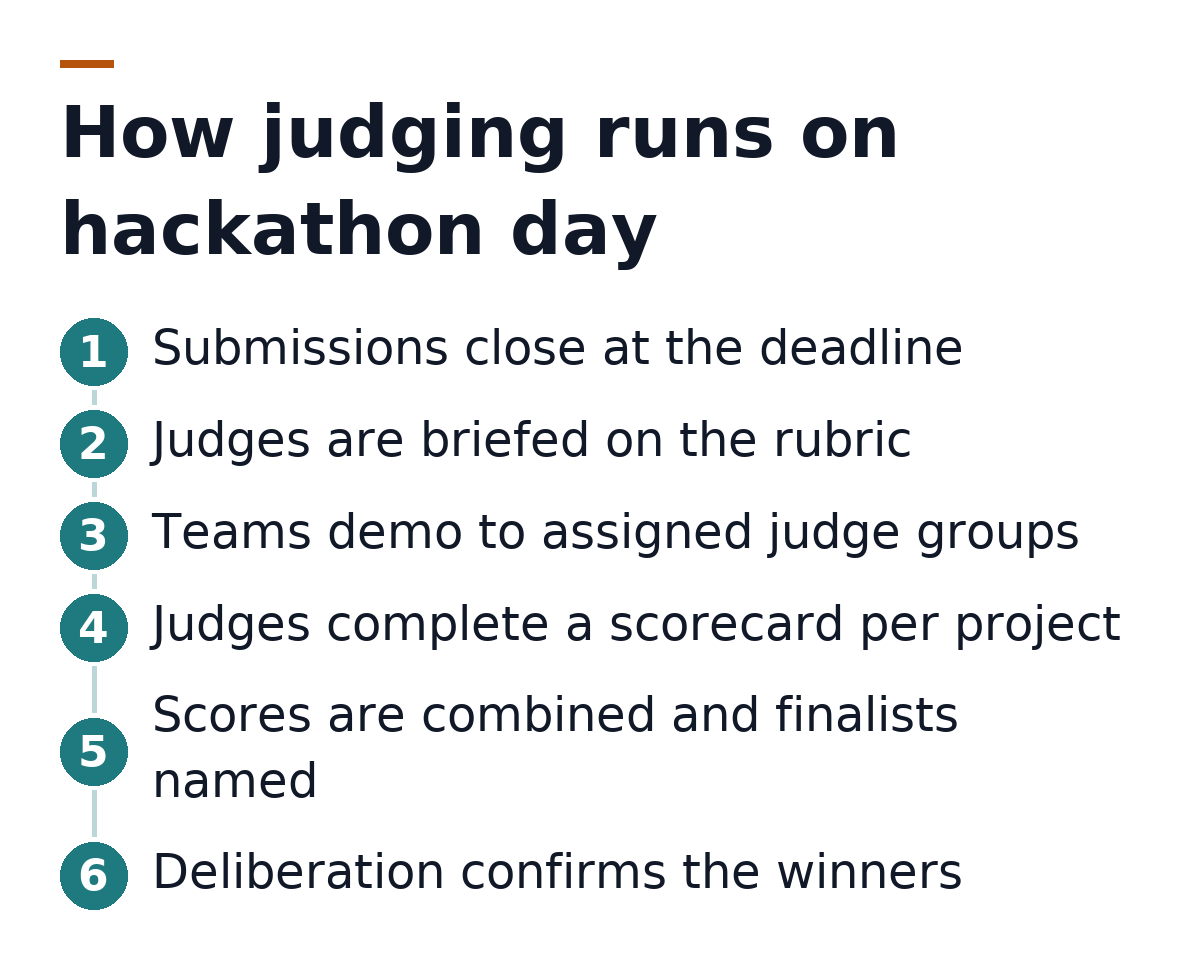
Hackathon winners are chosen by combining scores from several judges and then checking the result through a short deliberation. The math gives a ranking. The discussion makes sure the ranking makes sense.
Combining scores sounds simple, but organizers make real choices here. Some add up raw totals. Others average scores so that projects seen by more judges are not favored. Some normalize each judge’s scores, because one judge may give mostly 4s and 5s while another rarely goes above a 3. Normalizing evens out those personal habits so a project is not helped or hurt by which judges happened to see it.
Deliberation is where judges look at the top of the list together. They settle ties, check whether a high score came from a misunderstanding, and confirm that winners meet the rules, such as building during the event window. Good deliberation changes results only when there is a clear reason, and organizers keep a record of why.
Most hackathons award more than one prize. Common categories include:
A single project can sometimes win in more than one category, though some events limit each team to one prize so awards spread across more teams. Either approach is fine as long as the rule is announced before judging starts.
Judging is fair when every team is measured by the same standard, by people without a stake in the outcome, using rules everyone knew in advance. It breaks down when any one of those conditions slips.
These are the problems we see most often, at our events and in conversations with builders who attend others:
Events counter these with simple habits. They publish criteria early. They ask judges to declare conflicts and step away from those projects. They give each project scores from more than one judge. They brief judges on looking past presentation polish. And they keep scorecards so any participant who asks can understand how their project was evaluated.
Feedback is the other half of fairness. Teams that do not win still deserve to know what judges thought. Some events share written notes from scorecards afterward. At our events, judges are encouraged to talk with teams after results, because that conversation often matters more to an early-career builder than the score itself.
Sponsors, donors and volunteers each touch the judging process, but in different ways. Keeping those roles clear is what protects both the event’s credibility and the supporter’s reputation.
Corporate sponsors and CSR program managers. Sponsors often fund prizes and may offer a judge for their own track. That is a healthy arrangement when the sponsor prize has its own published criteria and the overall winners are decided by an independent panel. For a CSR program, the strongest outcome is visible: builders using your tools to make something useful, judged in a way participants trust. A sponsor who supports fair judging earns more goodwill than one whose prize looks predetermined.
Recurring donors and nonprofit supporters. Donors rarely judge, but their support pays for the things that make judging work: venue time for demos, food that keeps teams going through the final hours, and the organizing effort to recruit and brief a balanced panel. When you give to a community hackathon, you are paying for a weekend where a first-time builder can stand in front of experienced engineers and get honest feedback.
Volunteers. Volunteers keep judging on schedule. They guide judges to tables, time demos, collect scorecards and help tally results. Volunteering at a hackathon is also one of the best ways to see judging from the inside before you ever judge yourself.
Most hackathon judges are invited because they have experience in a relevant field and a willingness to give a few hours. Organizers look for people who can be fair, ask good questions and explain their reasoning. You do not need a famous title. You need enough experience to recognize good work in the area the event covers.
If you want to judge in 2026, these steps tend to work:
Judging opportunities cluster around specialties. An engineer working on AI agents is a natural fit for an AI-themed event, and a designer with accessibility experience brings something a panel often lacks. In our Discord, where 490+ builders talk through projects and announcements, we share volunteer and judging openings as each quarterly hackathon gets closer.
Judging also teaches the judge. Spending an afternoon watching dozens of teams solve problems under pressure sharpens your own sense of what makes a project clear, useful and well built. Many of our regulars say it changed how they plan their own side projects.
Whether you want to build, judge, volunteer or sponsor, C.O.D.E Philadelphia hosts quarterly hackathons and weekly coding sessions where Philadelphia builders of every level get real feedback on real projects. Join our community of 5,700+ members on Meetup, volunteer at our next hackathon, or support the events as a sponsor or donor so more first-time builders get their moment in front of the judges.
Powered by gofylo.io